
If Chaos and the Tyranids ever went to war, there’s no single winner. You get an endless stalemate. In a straight-up fight on the tabletop or in a sector-scale campaign, the Tyranids almost always have the edge — the Shadow in the Warp is a nightmare for any daemon. But zoom out to the galactic scale, and Chaos can’t be physically destroyed. The Ruinous Powers are woven into every soul that feels rage, hope, despair, or excess. The most likely outcome? A grinding, galaxy-wide stalemate that never ends. And that is exactly the kind of hopeless, no-win scenario Warhammer 40,000 does best.
Local Engagements: Tyranids Hold the Advantage
In a direct confrontation, the Tyranids have several built‑in advantages that stack the deck against Chaos.
The Shadow in the Warp is the big one. When a Hive Fleet moves in, the Hive Mind’s collective psychic presence floods the local Warp, blocking communication, astrotelepathy, and Warp travel. For daemons, this is a hard counter. They need a constant flow of Immaterium energy just to keep a physical form. Under a strong Shadow, that connection gets severed. Daemons start to flicker and dissolve, cut off from their sustaining power source. There are documented instances where the Shadow was intense enough to begin closing active Warp rifts.
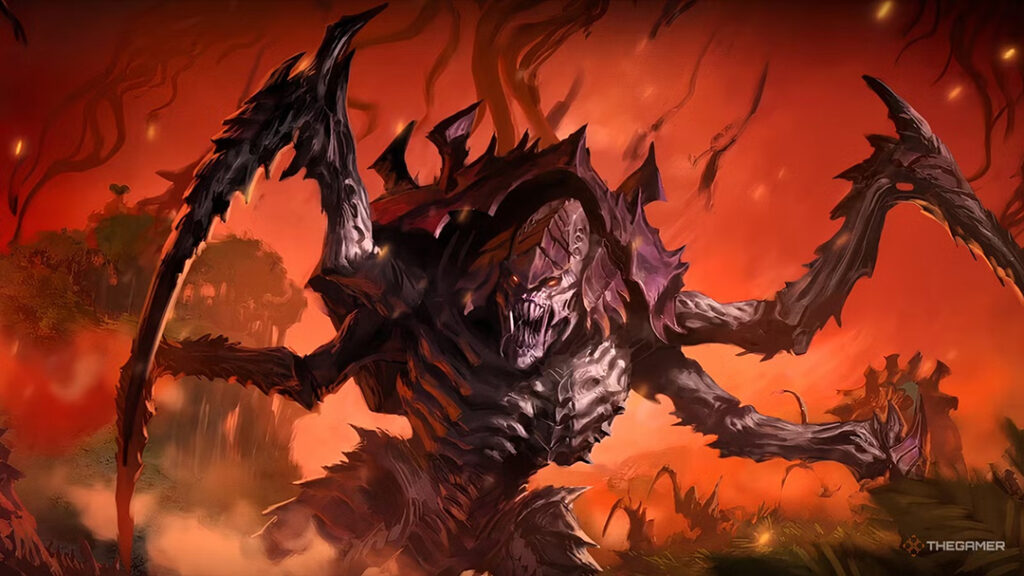
Corruption resistance also matters. The Hive Mind is a singular consciousness with no individual souls for Chaos to grab onto. No canonical case of a Tyranid organism being corrupted by Chaos has ever been recorded. That whole vector of attack — seduction, temptation, mutation — simply doesn’t work here.
Logistics is another clear win for the hive fleets. The Tyranids recycle everything. Biomass goes in, more gaunts come out. Daemons, once banished, need a fresh infusion of Warp energy to manifest again. And mortal Chaos forces — Traitor Marines, cultists, their supply lines — get hammered by the Shadow’s interference.
Chaos can still fight back, though. Mortal followers of the Dark Gods aren’t directly affected by the Shadow’s banishment effect. They can still put bolt rounds into chitin. Chaos can also strike strategically — hurling a Hive Fleet into the Warp with a sorcerous storm, or sending assassins to kill synaptic creatures like Hive Tyrants to disrupt local coordination. The two sides have clashed multiple times in official lore, with wins on both sides.
Notable encounters include:
| Battle / Campaign | Participants | Brief Summary | Outcome |
|---|---|---|---|
| First Battle of Shadowbrink | Hive Fleet Leviathan vs. Daemon Legions | Leviathan was consuming Shadowbrink when a Chaos artifact exploded, ripping open a Warp rift. Greater Daemons from all four gods poured out. The swarm drove them back but took heavy losses. | Tyranid victory |
| Second Battle of Shadowbrink | Hive Fleet Kronos vs. Khornate Daemons | After the Great Rift opened, Kronos (a fleet specifically evolved to fight Chaos) arrived. The Shadow was so intense it began closing local Warp rifts. The Khornate legions charged; Kronos answered with massed ranged fire, banishing them back to the Warp. | Tyranid victory |
| Kronos Fleet Engagements (various) | Hive Fleet Kronos vs. Chaos (cultists, Traitor Marines, daemons) | Kronos pushes along the Great Rift, hitting worlds marked by strong psychic activity. It purges Chaos‑corrupted planets like “maggots cleaning infection from a wound,” avoiding melee and relying on overwhelming firepower. | Multiple Tyranid victories |
| Octarius War | Hive Fleet Leviathan vs. Ork Empire of Octarius (Chaos occasionally intervenes) | A three‑way mess. Leviathan and the Orks are locked in a brutal back‑and‑forth. Chaos warbands sometimes jump in to exploit the chaos, hitting whichever side is exposed. | Mixed results |
Galactic Scale: No Clear Victor
When you pull the camera way back to look at the whole galaxy, the answer changes. This isn’t a battle anymore — it’s a cosmic equation with no clean solution.
Mutual annihilation is a theoretical possibility. If the Tyranids eventually consume every last scrap of organic life in the galaxy, all the races that feel emotion — that feed the Chaos Gods — go extinct. No rage means no Khorne. No schemes means no Tzeentch. No despair means no Nurgle. No excess means no Slaanesh. The Chaos Gods would wither and vanish. But the Tyranids, with no more biomass left to eat, would also shut down — no reproduction, no evolution, just a dormant, galaxy‑wide graveyard. Nobody wins.
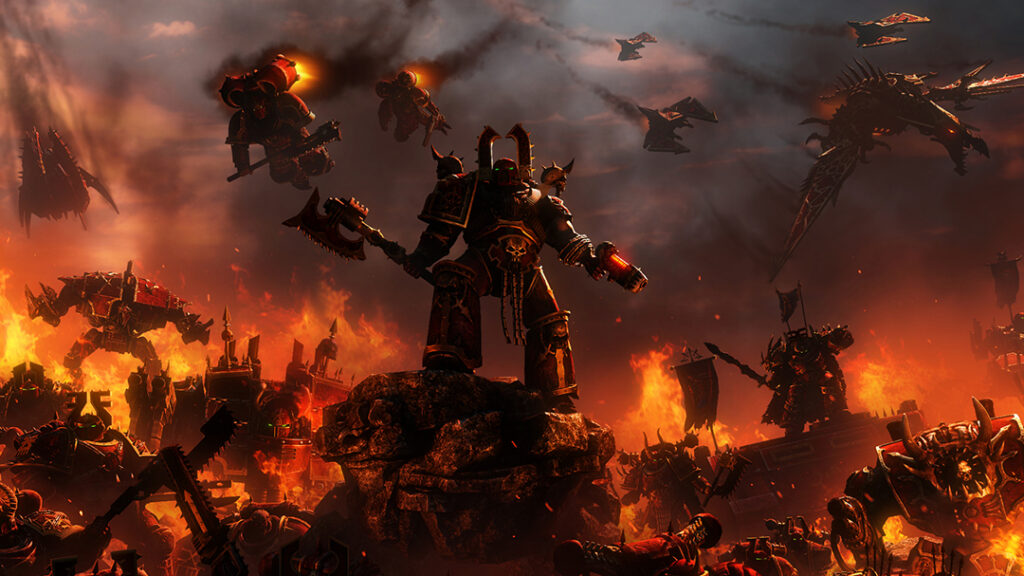
Endless stalemate is the more realistic outcome, and the one that fits Warhammer 40K’s bleak aesthetic best. Chaos can’t corrupt the Tyranids — there’s nothing to grab onto. The Tyranids can’t enter the Warp and kill the Dark Gods — that’s not how the Immaterium works. So you end up with a dynamic: the hive fleets eat everything on the galactic fringe, Chaos holds the Warp‑soaked core, and the two just… keep grinding against each other forever. Neither side can land a knockout blow. That’s the most likely future: not victory for anyone, just more war.
Why They Fight – The Background
What Chaos is: The four Ruinous Powers — Khorne (rage and bloodshed), Tzeentch (change and scheming), Nurgle (despair and decay), and Slaanesh (excess and sensation) — are psychic echoes of every thinking being’s emotions, projected into the Warp. Their daemons and mortal followers exist to drag the entire galaxy into the Immaterium.
What the Tyranids are: An extragalactic super‑predator. The Hive Mind is a single, overwhelming consciousness that controls every Tyranid organism. Their only drive is consumption — absorb biomass, adapt, reproduce, repeat. They have no individual souls, no emotions to tempt, no vulnerability to corruption.
Why they inevitably clash: For Chaos, the Tyranids are useless — they generate no emotional energy and can’t be seduced. For the Tyranids, a world under Chaos control still has biomass: human settlers, alien populations, even cultists. That’s food. The Hive Mind generally avoids Warp‑storm‑drenched sectors when possible, but when Chaos spreads into its hunting grounds, conflict is unavoidable.
Kronos Fleet deserves a special mention here. After the Great Rift tore the sky open and Chaos started swallowing whole sectors — stealing biomass the Hive Mind wanted — the Hive Mind did something remarkable: it evolved. It split off a new fleet, Hive Fleet Kronos, specifically designed to fight Chaos. Kronos generates an especially dense Shadow, fights at range to deny Chaos its preferred close combat, and methodically purges corrupted worlds. It’s the Hive Mind’s immune response to the Chaos infection.
No one wins this fight. At the local level, the Tyranids usually come out on top. At the galactic level, Chaos is woven into the fabric of the setting. The two sides will keep grinding against each other, sector by sector, century by century, until something else breaks the galaxy first. And that, really, is the whole point of Warhammer 40,000. There are no saviors. No final answers. Just war, forever. The Chaos–Tyranid matchup is just one more front in that endless, hopeless conflict.